
Taylorsville City Directory Collections
The historical shelf for Taylorsville is the wider Salt Lake City and Salt Lake County directory universe. The County Archives reports a useful local run from 1958 through 1983, with a few later years reaching 1999. The University of Utah Marriott Library and the Utah History Research Center are described as holding nearly complete older sets back to 1869. Those books cover residents, renters, businesses, and institutions across the valley, so an entry may use Salt Lake City, Taylorsville, Bennion, or another older place label instead of the present city name.
| Collection | Years | Where Held | Access |
|---|---|---|---|
| Polk Salt Lake City and suburban county books | 1869 start for near-complete Marriott and Research Center runs; post-1924 pink pages | Utah History Research Center, Marriott Library, County Archives | Reading room, catalog copies, and selected digital scans |
| Salt Lake County Archives shelf | 1958-1983, plus a few years through 1999 | Salt Lake County Archives | Appointment-only research access |
| Utah City Directories Collection | Varies by item; no complete run claimed | Mountain West Digital Library | Free collection browse and search within available books |
| 1869 Salt Lake City Directory and Business Guide | 1869 | Library, archive, and established genealogy copies | Catalog search and digitized copies where available |
| FamilySearch, Ancestry, and Internet Archive copies | Items include 1885, 1890s, 1901-03, 1909, 1912-13, 1920-23, and later years | County Library and digital collections | Catalog search; Ancestry Library is on-site only |
Coverage is not the same as a complete Taylorsville series. A book may be printed for Salt Lake City and include nearby valley addresses, while another may omit a suburb or skip a year. Save the catalog record, title page, publisher, city heading, and page number with each find. A missing name may mean a skipped volume, a spelling difference, an unlisted person, or a move. It does not by itself prove that the person was absent from the valley.
Salt Lake Shelves for Taylorsville City Directories
The County Archives is the most direct local stop for its 1958-1983 shelf and later selected years. Its reading room is appointment-only. The Archives describes online and browsable series beside the directories, including deeds, plats, tax rolls, maps, citizenship records, water records, and tax appraisal photographs. Research time is free for the first 15 minutes, then staff research is $25 per hour. Copy charges depend on the item, with rates identified for page, microfilm, image, certified-request, and mailing work.
The Taylorsville Library is at 4870 S 2700 W and can help with catalog work and local-history access. Its phone is 801-943-4636. Hours are Monday through Thursday, 10 a.m. to 9 p.m., Friday and Saturday, 10 a.m. to 6 p.m., and Sunday closed. Ancestry Library is on-site only, so a home connection does not replace a branch visit. The County Library genealogy desk also points to Utah Digital Newspapers, Utah NewsSearch, Chronicling America, census material, maps, and other Utah records.
The Utah History Research Center at 300 S Rio Grande in Salt Lake City is a human research channel when a scan or catalog entry does not settle a question. Its phone is 801-245-7227. Staff describe trying spelling variations, alternate terms, newspapers, and the Recorder or Assessor for house-history questions. The Historical Society finding aids add a Taylorsville-Bennion Heritage Oral Histories Collection from 2008, Bennion Family Papers from 1842-1960, photographs, and related valley material.
Browse Taylorsville City Directories Online
The MWDL collection is useful because its arrangement offers more than one way into a volume. Books are organized alphabetically, geographically, and by publisher, and the collection describes residents, streets, businesses, organizations, institutions, and advertisements. Use the collection landing page to identify an available item, then read the book title and year before treating a result as evidence about Taylorsville. The surrounding valley may be present even when the book title names Salt Lake City.
Digital access still has limits. The public collection description does not claim a complete year run or expose every page field. FamilySearch and Internet Archive copies can fill some gaps, and the County Library provides licensed Ancestry access in the branch. When a page image is restricted, note the catalog title and ask a librarian, archivist, or Research Center staff member about the physical copy. Keep the search path with the result so another researcher can repeat it.
A practical online search uses the name in several forms. Try a surname with initials, a full given name, a maiden or former name where relevant, hyphenation variants, and the older community label. A street search may need a direction, an abbreviated street type, or the form printed in that year. The Research Center specifically warns that alternate spellings and terms can decide whether a result appears.
Here is the digitized collection view that supplies statewide and valley context for a Taylorsville city directory search.
Open the Utah City Directories Collection description and search controls.
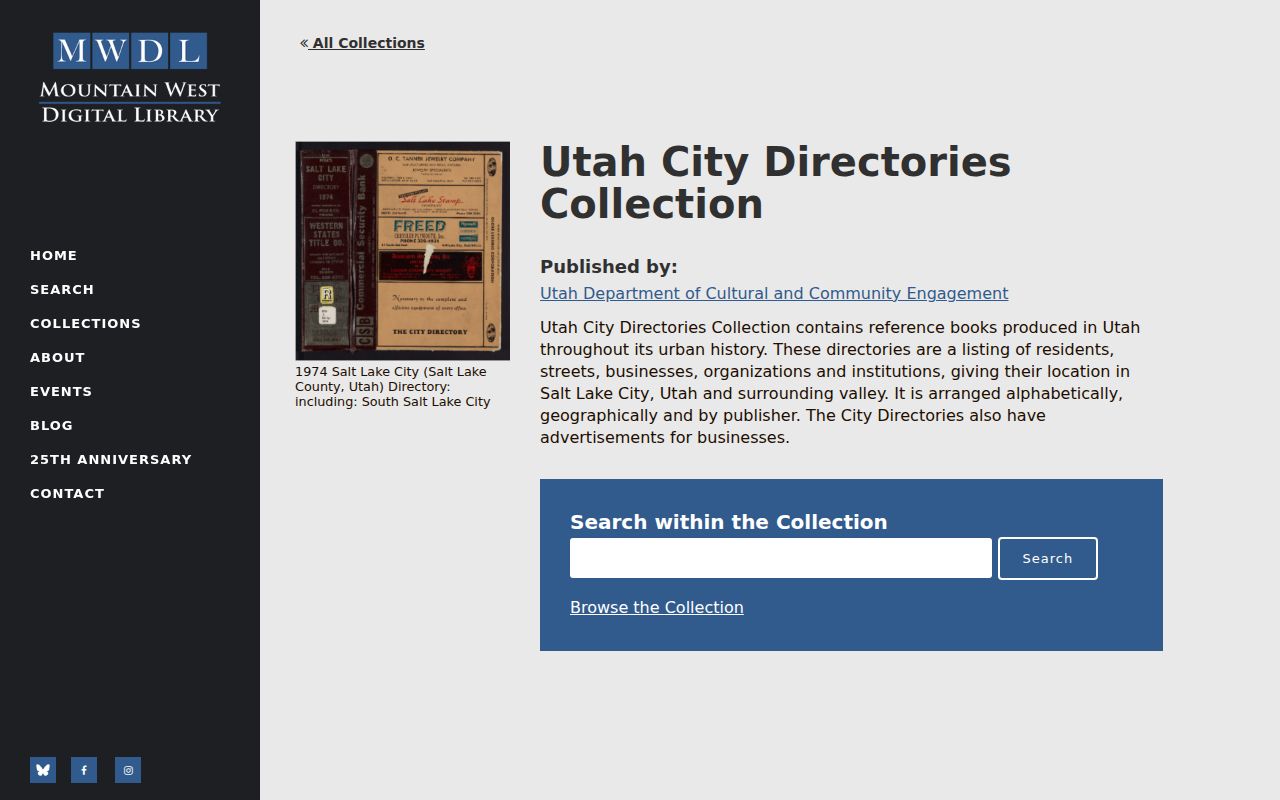
The collection screen is a starting point for locating a book, not a claim that every Taylorsville page is digitized or indexed.
The Polk Pages Behind Old Addresses
After 1924, the Utah Historical Society Research Center describes Polk street pages, often called the pink pages, as a direct route from an address to its occupant. The street section is read by street name and house number, then the occupant can be checked in the alphabetical section. This reverse path is useful when a family name is unknown. It also makes an old Taylorsville address searchable even when the book was published for the broader Salt Lake area.
For a question before 1924, the Research Center may turn to newspapers and preservation files, then refer the researcher to the County Recorder or Assessor. Utah Digital Newspapers can be searched by keyword, article title, wedding, death, and birth. Utah NewsSearch offers searchable newspaper PDFs with filters for newspaper, city, county, or ZIP. These sources can reveal a move, obituary, farm or road name, or business tie that explains why a directory entry changed.
Note: Pre-1924 address work has a documented newspaper fallback, but no verified complete local criss-cross year run was located.
Reading a Taylorsville City Directory Entry
A directory entry is a compact record of how a publisher described a person in one year. Formats vary, so transcribe what the page actually prints. The surname may lead, followed by a given name or initials, street number, street name, spouse in parentheses, occupation or business, room or unit, and a mark for a householder or renter when that run uses one. A street page reverses the order and may list a house number before any name. Telephone books can add an exchange or number, but they are not a full list of every person at an address.
| Name | Surname first, then given name or initials; spouse details appear only when printed. |
|---|---|
| Address | House number and street as printed, with direction or unit marks where shown. |
| Occupation or business | A trade description, and sometimes an employer or business name. |
| Household mark | An owner, householder, renter, boarder, or similar symbol when defined by the volume. |
| Publication proof | Title, year, publisher, page, city or suburb heading, and section used. |
The sample-entry inventory is the page citation itself: person, address, occupation or business, spouse or household notation, publication details, and the abbreviation key. If a field is not visible, leave it blank. Do not turn a conditional format into a fact about a particular Taylorsville household.
- Criss-cross directory
- A reverse directory arranged by address or phone so a search can begin with a place instead of a surname.
- Householder index
- A name or household listing pointing to the principal person associated with an address; it is not a complete household census.
- Abbreviation key
- The publisher's explanation of short forms and symbols, which should be read before interpreting an entry.
- Pink pages
- The Research Center's name for Polk street and address pages used after 1924 to identify occupants.
Census Pairings for Taylorsville Directories
A city directory is a publication snapshot. A federal census is an enumeration that can add household relationships, age, race, and occupation fields. The released census years relevant to this shelf are 1900, 1910, 1920, 1930, 1940, and 1950. The 1950 schedule is the latest public census under the 72-year release rule noted in the research. Pair the nearest directory year with the nearest released census rather than expecting either source to show a complete present household.
- Choose the target year and write the exact street and place wording from the directory title page.
- Read the street or pink-page section, recording each name, number, mark, and page citation.
- Check the alphabetical section for initials, spouse, occupation, business, and alternate address forms.
- Compare the nearest released census year, then mark the years with no directory or census coverage.
- Use an obituary, cemetery entry, newspaper, or oral history to test a move, death, or family connection.
Disappearing from a directory has several possible causes. The person may have moved, died, changed a name, been left out, or appeared under a different city or street form. A census household, obituary, cemetery record, and later directory can help separate those possibilities.
Taylorsville Directory Timeline
Several dates give the shelf its shape. They are collection and records milestones, not proof that every year contains a Taylorsville entry.
| 1848-1850 | Over Jordan settlement west of the Jordan River develops, before modern municipal naming. |
|---|---|
| 1869 | Near-complete Marriott and Research Center directory runs begin with the earliest cited Salt Lake directory baseline. |
| After 1924 | Polk pink pages provide the documented address-to-occupant route. |
| 1958-1983 | County Archives holds a practical local directory run. |
| Through 1999 | A few later County Archives years extend beyond the main run. |
| 1996-1997 | Taylorsville incorporates in 1996; Recorder property documents begin digital scanning in 1997. |
The timing matters because an old entry can be filed under Taylorsville, Bennion, Over Jordan, a ward, a precinct, a farm, or a road landmark. The reviewed sources did not identify a complete local criss-cross run or a verified citywide street-renumbering year.
Taylorsville Names Across Time
Directory work needs local geography. Joseph Harker moved west of the Jordan River in 1848, ten families followed in winter 1849, and the community centered between about 4300 and 4800 South by 1850. The area counted 178 residents in 1860, stayed largely agricultural through the 1940s, saw faster suburban growth around 1960, and became an incorporated city on July 1, 1996.
Test Taylorsville, Bennion, Over Jordan, a ward or precinct, a farm, and a road landmark. Redwood Road, Murray-Taylorsville Road, 4800 South, canals, and the Jordan River can be better search anchors than a present city label. The Rock Schoolhouse, Taylorsville Mercantile area, and 4800 South Historic District add context for older business and household entries.
The cemetery search can close a family trail with born, died, and interred dates, cemetery and grave location, veteran, rank, branch, war service, variant name, space type, and memorial fields. The cemetery is an endpoint, not proof that a person lived at its city address. Sanborn maps from the 1880s through the 1960s, including newly recognized 1926-27 maps, can date building footprints and street form, but they do not identify every resident.
Here is the local burial-search interface used as a careful endpoint for names that surface in a Taylorsville city directory.
Open the Taylorsville municipal cemetery search.
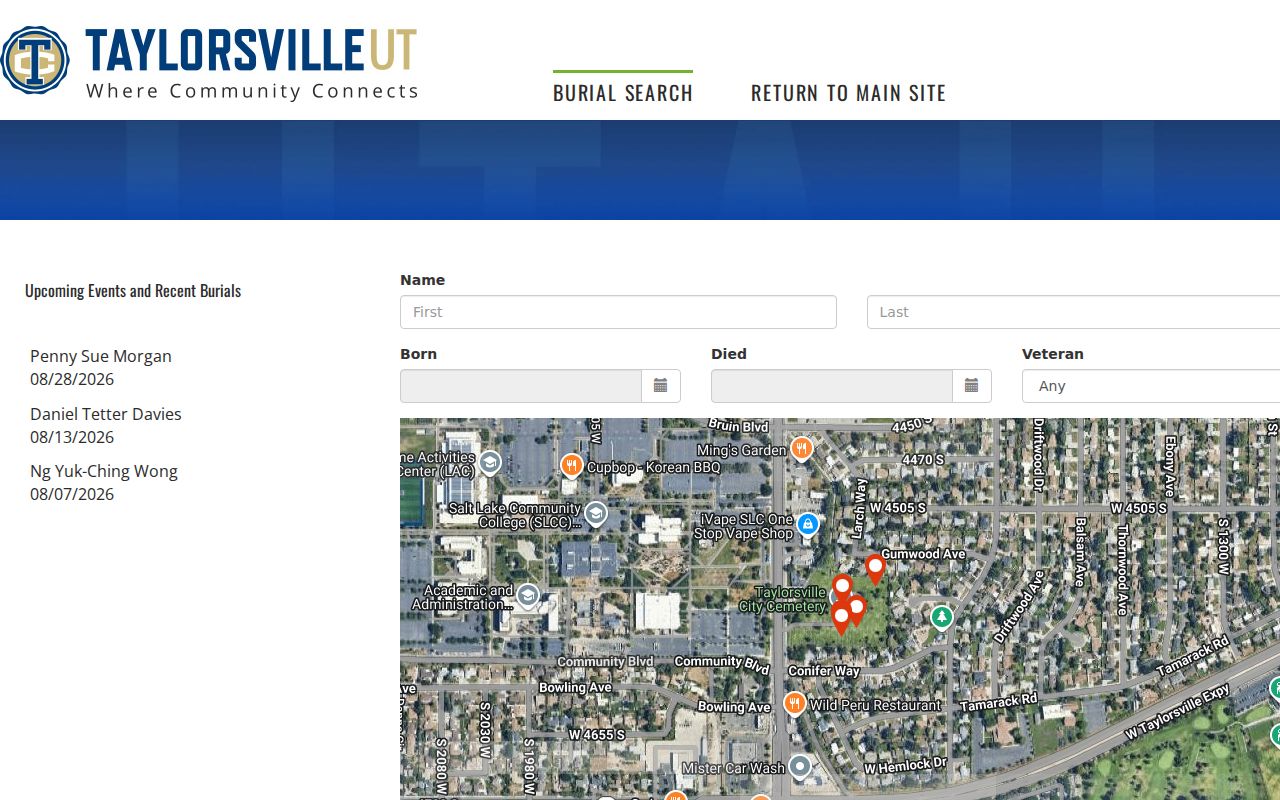
The cemetery fields can support identity matching, while the directory and census provide separate time and household context.
Note: Official pages did not identify a complete Taylorsville-specific digitized page image, local criss-cross run, or street-renumbering year.